

Triage, drafting, summarizing long threads, finding the part that matters, writing in your voice, cutting repeat replies. Making the inbox cost you less.
Most executives use AI at a small fraction of what it could do for them.
Usually because nobody has ever sat with them for an hour and worked through it on their own material. That's what this is. One 90-minute session a week, online, screen shared, on the real thing.
You'll be doing it yourself by the end of the first session.
No deck, no pressure. We look at your situation and tell you honestly whether this helps.
- What it is
- Private 1:1 AI coaching for senior leaders
- How often
- One 90-minute live session a week, online, screen shared
- What we work on
- Your real work. No exercises, no case studies.
- Between sessions
- A member app built around you, and direct access when you get stuck mid-task
- Commitment
- Month to month
AI is usually the second problem.
The reality
Look at what's happening on a senior person's laptop before you look at how they use AI. The inbox never quite ends. Files live in five places. The notes from Tuesday's meeting are somewhere. Three browsers are open and nobody remembers why. Follow-ups run on memory. The calendar decides how the day goes.
Then every week someone forwards another article about agents, prompts, Copilot, ChatGPT, Claude, automation, or whatever is supposedly about to change everything.
Why it doesn't stick
That's the real starting position for most people, and it explains why AI training so often fails to stick. Most of it assumes clean folders, a task system you trust, decent note habits, and comfort moving between tools. Plenty of very capable people have none of that, which is what happens when work gets more digital every year and nobody stops long enough to rebuild how it runs.
Where we start instead
So we start with your Tuesday instead of the most impressive use case. Sometimes the first genuinely useful hour goes on choosing one browser and moving everything into it. That sounds unrelated to AI. It usually turns out to be the hour that makes everything after it work.
From there we look for the easy wins: the repeated tasks, the annoying steps, the places where you copy, paste, search, rewrite, summarize, chase, format, or make the same kind of decision again and again.
AI gets useful there first.
You bring the real thing and we work on it together.
Ninety minutes, weekly, online, screen shared.
Bring whatever is actually in front of you. An inbox that's gotten away from you. A proposal you're dreading. A board update. A recurring process. A tool you can't figure out. A decision you keep postponing because gathering the information is exhausting.
We work on it live, and you do it yourself with someone sitting there, which is the part that makes it stick.
Some weeks that means rebuilding how you handle email. Some weeks it's a proper way to prepare for meetings and capture what was decided. Sometimes we build a custom GPT or Claude project for your writing, research, or proposals. Sometimes an automation. Sometimes we vibe code something small because no off-the-shelf tool solves your particular problem. And occasionally the right answer is to leave AI out of it, because the simpler fix is better.
There's no curriculum to get through. Your work is the curriculum.
What happens after the session ends.
Coaching tends to fail in the same place. The session is good, you leave with momentum, and by Thursday you're back to the old way because the new way took thirty seconds longer and you were busy.
Every member gets an app built for exactly that gap.
Practice prompts, within an hour of your session.
By the time you're back at your desk, the techniques we just worked on are waiting as ready-to-use prompts, written around your actual work. You'd use them on real tasks that same day.
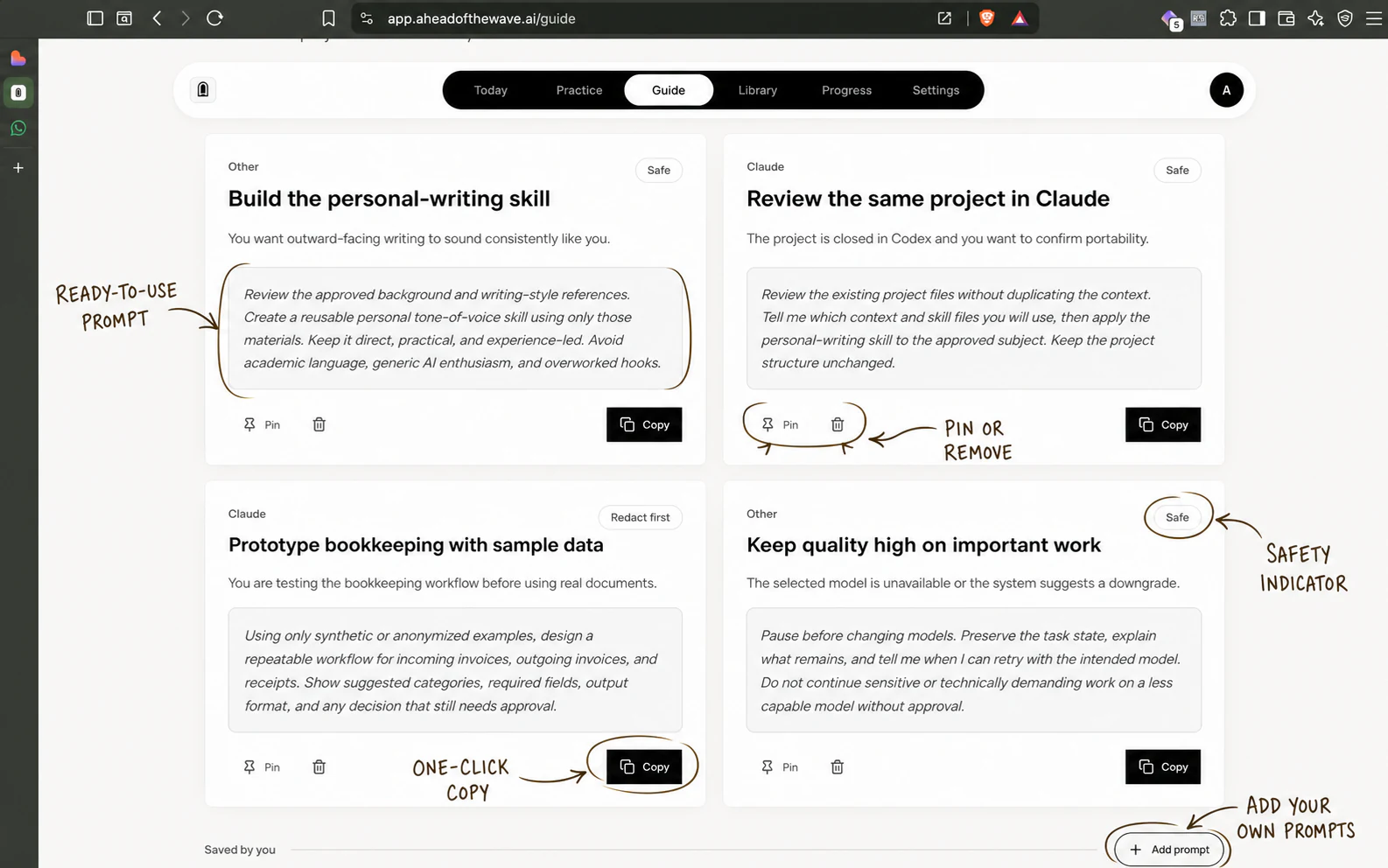
A guide for when you're stuck.
The one members open most. You know the technique, you're looking at your screen, and you have no idea where to begin. The guide walks you through applying it to your own workflow, one step at a time. Click next, get the next step. Built around the process you already use.
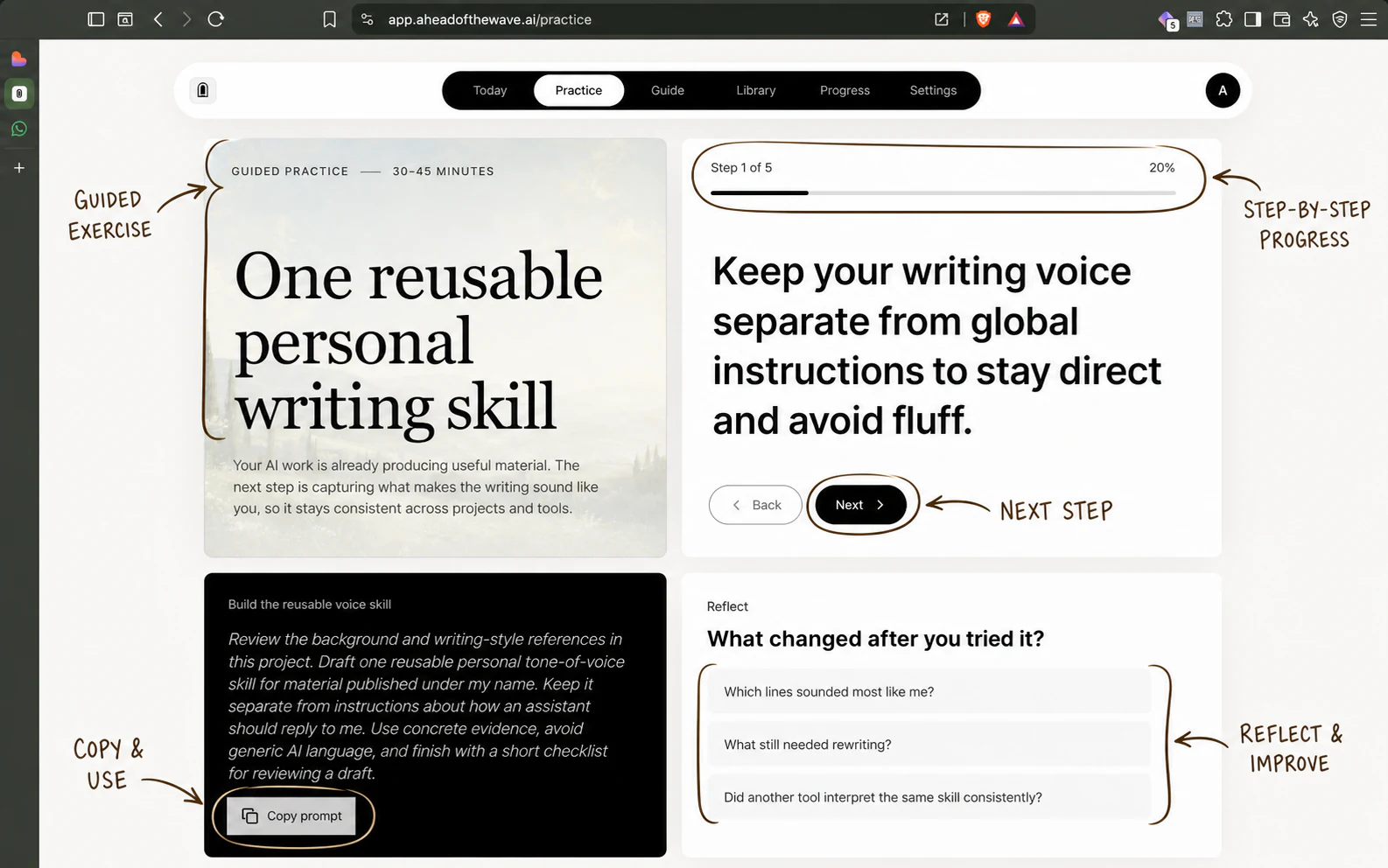
A library that keeps growing.
Short videos and material chosen for your situation, added continuously rather than dumped on you at signup.
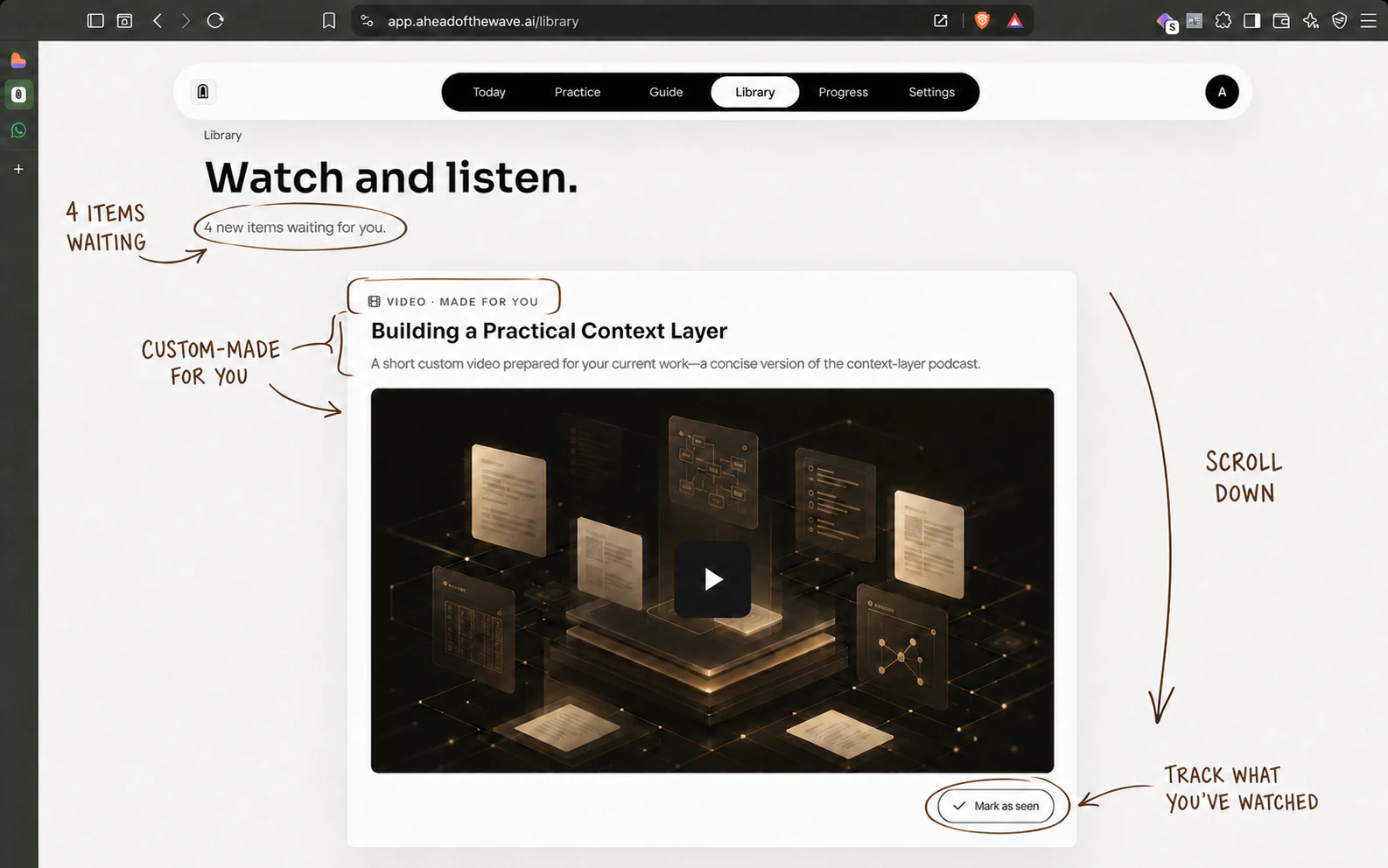
Podcasts about your work.
This one surprises people. AI-generated audio, realistic enough that you'll forget it's AI, discussing your situation, your name, your actual work. Members listen in the car. Hearing your own workflow talked through turns out to teach better than any general explanation of AI.
Everything we've built, in one place.
Session history, what we made, where you are, what's next. Nothing gets lost between weeks.
When something breaks at four on a Wednesday.
This happens often. A member is deep in something with AI, it's going well, they're moving fast, and then it stops working. Wrong output, the tool won't do the thing, no obvious next move.
That's the worst possible moment to lose momentum, and it's usually where people quietly go back to the old way.
So they message on WhatsApp. Sometimes they just call. Ten minutes, sorted, back to work.
That's part of the membership. No ticket, no separate invoice.
Where you land depends on where you start.
Two things decide how far you get. Where you're starting from, and how fast you want to move. They're connected. People who arrive with a decent setup can move quickly. People starting from a messier place usually can't, even when they want to, and pushing them faster just breaks things.
Both get measurable results in three months. They look different.
Starting from a chaotic setup
No folder structure, nothing where you'd expect it, email that's more swamp than system, three browsers, a few things that have been broken for two years.
Three months in, everything has a structure and you know where things are. Your setup stops fighting you and you move faster through your own machine. An AI assistant is properly integrated into your desktop, doing real work, with permissions you understand and chose deliberately.
Starting already ahead of the room
You use ChatGPT or Claude daily. Colleagues ask you things. You want to go considerably further than you are.
Three months in, your workflows are AI-powered rather than AI-assisted. Real automations running. Custom tools built around how you specifically work. Quite possibly software you've built with AI that you'd never have attempted before.
Most people sit somewhere between the two. The discovery call is where we work out which end you're closer to and what three months would realistically look like for you.
The law already expects your people to be AI literate.
Article 4 of the EU AI Act asks organizations to make sure the people using AI on their behalf actually know what they're doing. It's been in application since February 2025, and supervision starts in August 2026.
Put the compliance question aside for a moment, because the reasoning behind it is the interesting part. Someone looked at how these tools are spreading through organizations and decided it isn't safe or sensible for people to use them without understanding them. That seems right.
Which raises an obvious question. If everyone in the organization is expected to reach that level, where does that leave the person deciding which tools the organization buys, what data goes into them, and which work gets automated?
Most executives delegate the learning, and it's an understandable instinct. The problem is that AI judgment doesn't transfer secondhand. You can be briefed thoroughly and still have no feel for what these tools can actually do, where they fail, and which parts of the excitement are noise. That feel comes from using them on your own work, which is the fastest route to it and possibly the only one.
The work is different for everyone. These are the usual places we begin.

Calendar and meetings
Preparing properly, capturing decisions, turning notes into follow-ups, keeping context from vanishing the moment the call ends.

Documents and presentations
Drafting, restructuring, simplifying, translating, and getting to a solid first version of memos, proposals, reports, and decks far faster.

Research and reading
Comparing sources, summarizing long documents, preparing briefings, turning scattered reading into something you can act on.

Your own knowledge
A simple way to store and reuse your thinking, your examples, your templates, the explanations you give over and over.

Custom AI tools
Custom GPTs, Claude projects, prompt systems, research and writing assistants built around your work.

Tool choice
When to use ChatGPT, Claude, Copilot, Gemini, Perplexity, Notion, Zapier, Make, or nothing at all.

Automation
Reminders, summaries, routing, document flows, data cleanup, and the admin steps you keep doing by hand.

Digital foundations
Browsers, files, folders, devices, and the setup everything else sits on. The least exciting item here and often the highest-leverage hour we spend.
A weekly rhythm, because that's what makes it hold.
Discovery call.
We talk about your work, your tools, your comfort level, and what's currently heavier than it should be. If it isn't a fit, we say so.
We map your setup.
In the first sessions we go through your digital environment: email, calendar, files, notes, meetings, AI tools, recurring tasks. You get a personal AI Setup Map covering what you use, what needs cleaning up, what can improve this week, and what's worth building over time.
Weekly sessions.
Ninety minutes, screen shared. One useful thing, real progress on it, live.
You use it, we refine it.
Between sessions you use what we built. Next week we fix what broke, simplify what felt heavy, or move on.
It compounds.
After a few weeks this stops feeling like AI experiments. Your tools connect. Your habits change. You know what to use, when, and what to ignore.
One membership, everything in it.
- Weekly 90-minute 1:1 working sessions, screen shared, on your real work
- Your personal AI Setup Map in the first month
- Full member app access: practice prompts after every session, the step-by-step guide for when you're stuck, your growing library, and podcasts made around your work
- Custom prompts, workflows, GPTs, Claude projects, and automations built for you
- Custom video tutorials for your specific setup
- Direct support between sessions by WhatsApp or email, including short calls when something breaks mid-task
- Session continuity, so we never restart from zero
- Recordings and summaries where they're useful
- First access to new AOTW member resources
- Month to month
What it costs.
We share the number on the discovery call, and we share it in the first few minutes rather than saving it for the end.
Two things move it: how much building happens between sessions, and whether we're working with people around you as well as you. By the time we discuss it we'll have talked through your setup, so it isn't a guess on either side.
- Weekly 90-minute 1:1 sessions
- Your AI Setup Map
- Member app access
- Custom tools, workflows, and video tutorials
- Between-session support
- Session continuity
For capable people who are tired of feeling clumsy with modern tools.
Probably you, if you're
- A founder, executive, owner, consultant, board member, or senior professional
- Responsible for serious work and quietly tired of feeling behind on AI
- Using digital tools every day, not always comfortably
- Curious about AI and unimpressed by the hype
- Too busy for a course
- Someone who learns by doing rather than watching
- Willing to show your real workflow, mess included, and improve it week by week
Probably not, if you want
- A general AI course
- Someone to run your whole IT setup
- Results without changing any habits
- Emergency technical support
- To discuss AI at a strategic level and never touch the tools
The work gets practical, sometimes very practical. That's what makes it worth the ninety minutes.
Your data stays yours.
We work through screen share, so there's no need for direct access to your inbox, files, systems, or company accounts. You decide what we look at.
If something is sensitive, we work around it. Dummy examples, anonymized details, or simply keeping private material out of AI tools.
Session notes and transcripts, where we use them, exist so we remember what we built and what comes next.
If your company wants an NDA or a compliance conversation first, that's normal and we do it often.
Enterprise AI experience, in a room of one.
Ahead of the Wave is a European AI consulting company working across the DACH region and beyond. We've worked on AI transformation with 150+ organizations: enterprises, chambers of commerce, institutions, mid-sized companies.
This is the individual version of that work. Same approach, much smaller room. Instead of moving a whole organization, we make one person more capable at the work they already do.
As an executive managing multi-entity corporate roles, email volume and constant context-switching were severely impacting my strategic focus. Ahead of the Wave introduced tailored AI triage systems and voice-driven workflows that reduced my meeting preparation time by over 70%. Their approach respects executive health boundaries and focuses purely on high-impact, practical tools. It has completely transformed how I prepare for board meetings and manage daily operations.
DUAL-ENTITY INBOX OVERLOAD · LOCKED CORPORATE IT · HEALTH-BOUND WORKLOAD
Accelerated complex deal analysis from days to minutes.
Evaluating corporate investment opportunities used to require days of scanning dense consultant decks and market filings. Through Executive AI Coaching, I mastered deep research models and local AI workspaces. I can now condense complex acquisition targets into precise, two-page valuation summaries complete with due-diligence questions in under ten minutes. The return on investment was immediate.
Managing Director, M&A and strategy advisory ACQUISITION TARGETS · FINANCIAL PITCH DECKS · MARKET RESEARCH
Expert technical knowledge, unmatched executive empathy.
Many AI consultants push complex software without understanding corporate realities or administrative constraints. Ahead of the Wave stands out for their patience, human-centric approach, and strict adherence to data privacy. They guided me step-by-step through setting up custom AI agents without violating corporate IT policies. They are the ideal partners for senior leaders navigating digital transformation.
Senior executive, corporate governance and IT ADMINISTRATIVELY LOCKED DEVICES · GDPR COMPLIANCE · NO-TRAINING DATA BOUNDARIES
Replaced manual friction with fluid, voice-driven AI systems.
Ahead of the Wave doesn't teach superficial prompt tricks; they help you build a machine-readable personal operating system. Shifting to voice dictation, custom context layers, and automated document reformatting eliminated my administrative friction entirely. I now synthesize complex technical manuals and prepare for high-stakes client workshops seamlessly during my daily commute.
Supply chain advisory executive, professional services WORKSHOP MATERIALS · MOBILE AUDIO LEARNING · TECHNICAL MANUALS
Shifted from hours of manual drafting to effortless output.
I used to spend up to six hours typing manual prompts to refine corporate presentation decks and translate financial spreadsheets. Ahead of the Wave showed me how to structure voice-driven context files and deploy desktop AI tools. Drafting brand-aligned presentation copy and strategic intelligence now happens in a fraction of the time, completely removing technical frustration.
Corporate board director, private equity portfolio INVESTMENT PROPOSALS · SLIDE DECKS · CROSS-BORDER PORTFOLIO COMMUNICATIONS
Short answers to fair questions.
No. If you can use email, a browser, and a video call, we can start.
Good, we'll go further and faster. Most people use AI occasionally rather than as part of how they work. Closing that gap is the whole job.
English.
Both. We start wherever the friction actually is. Often that's something basic, and fixing it is what makes the AI part work.
Whatever you already have. Outlook, Gmail, Teams, Google Workspace, Microsoft 365, ChatGPT, Claude, Copilot, Perplexity, Notion, Zapier, Make, or others where they fit.
The session is ninety minutes. Beyond that, as much or as little as you want. The people who move fastest use what we built during their normal work rather than setting aside separate practice time, and the app is designed to make that easy.
It supports them. Article 4 asks organizations to ensure AI literacy among the people using AI on their behalf, and this is about as direct a route to that as exists for a senior leader. We can document the engagement if your compliance team wants that on file.
Yes. It usually sits under professional development, coaching, advisory, or training. We invoice.
Yes. NDA available.
We sort scheduling out at the start. The weekly rhythm is what creates momentum, so it's worth protecting, though nobody's rigid about it.
Yes.
Ideally you need less help, because your setup is better and your confidence is higher. Some members keep the weekly rhythm, some move to something lighter, some stop once they have what they came for. All fine. We're building capability, and capability that depends on us permanently isn't capability.
Let's look at your actual week.
The real one. The inbox, the files, the meetings, the AI tools you tried and abandoned, the parts that feel slower than they should.
On the call we'll go through where you are and what we'd fix first. If this is right for you, we'll say so. If something else would help more, we'll say that instead.